Categories
From the Clergy Uncategorized

Lenten Devotions for 2023

The season of Lent is a time to craft a few extra moments for prayer and reflection. Here are a few materials to help you with that.

Episcopal Relief & Development

Who is My Neighbor?

This Lenten Season, Episcopal Relief & Development invites you to join us as we meditate on the commandment to love our neighbor and consider the meaning of this fundamental instruction in our daily lives. You may subscribe to receive a daily meditation by email or visit the page to read a weekly meditation.

Living Compass

Living Well Through Lent: Practicing Compassion with All Your Heart, Soul, Strength, and Mind. 

A daily devotion that you can download or receive each day via email.

Water and Spirit

Water and Spirit provides daily devotions for each day from Ash Wednesday to Easter. Devotions begin with an evocative image and a brief passage from the Gospel of John. The writers then bring their unique voices and pastoral wisdom to the texts with quotations to ponder, reflections, and prayers. This devotion is a printed booklet that will be available in the Narthex on Ash Wednesday in regular and large print.

Lent Is Not Rocket Science

Lent Is Not Rocket Science: An Exploration of God, Creation, and the Cosmos

The season of Lent prompts us to ask questions, big and small, about the nature of our being and about our role in the world. In these daily Lenten reflections, astronomer, physicist, and Episcopal Bishop W. Nicholas Knisely explores the intersection of faith and science, creation and the cosmos. This devotion will be available in the Narthex as a printed booklet.

— The Rev. Stephanie Allen

Categories
From the Clergy Uncategorized

Episco101

Episco101: What you need to know about the Episcopal Church (but maybe didn’t know where to ask)

This Lent, you are invited to bring your questions about being an Episcopalian, and the clergy are going to do their best to answer. Perhaps you have questions like…

  • Why do some people make the sign of the cross during the service and others don’t?
  • What is that motion Deacon David used to make when he announced the Gospel?
  • What is that light above the box on the wall beside the altar?
  • Does the Episcopal Church do a “First Communion” ceremony?

There will be a wooden box in the Narthex for you to place all your questions. Phillip and I will take them and offer answers either in a blog post or a short video each week during Lent. 

Then, on March 26, the Fifth Sunday of Lent, we will hold an open forum after the 10:30 service for any and all questions that have not yet been addressed or asked. 

— The Rev. Stephanie Allen

Categories
Uncategorized Veterans

Why “Veterans@Nativity”

I have been a chaplain with the Veterans Health Administration (VA) for ten years. I’m not a veteran myself, but I have friends and family members who have served and are serving in various branches of the military. In my time at the VA — first as a trainee and now as a board certified chaplain and chaplain educator — I have cared for numerous veterans struggling to connect their faith with their service, military with civilian lives. 

Some people struggle with post-traumatic stress; others with moral injury. Some are part of a religious community; others stopped believing in God after what they’d seen or done. Still others would like to find a place to call their spiritual home — but they might have trouble with crowds. Or they’re tired of explaining why they have a service dog. Or they’ve been asked one too many times, “did you ever shoot anyone?” Or they’ve been told one too many times, “thank you for your service,” and felt that it was as sincere as a “God bless you” after a sneeze. 

Again, I’m not a veteran. I work in the VA, but I’m a civilian. I’ll always be a bit on-the-outside-looking-in — and that’s okay. I’ve also made some of those same conversational blunders I describe above. And that’s okay, too. What our veterans need — what each of us needs — is a space to have real conversations: about what hurts, about what healing looks like. Real talk about how we sometimes hurt each other as we’re healing or trying to be helpful. That’s real community, being part of the Body of Christ.

As a member of Nativity, I’m hoping our congregation can become the kind of community that is willing to have these real conversations together. I’d love it if veterans, service members, and family members could find a home for dialogue and engagement: even if they never attend a worship service. 

Will you help me explore what this might look like? If you feel led to explore this journey with me, I invite you to participate in one of the upcoming Veterans@Nativity coffee hours, or the four-part formation series we’ll be hosting later this Spring. All are welcome! In fact, that’s what it’s all about.

Grace and Peace, 
— Ryan Parker

For more information about Veterans@Nativity: Email Ryan Parker

Upcoming Veterans@Nativity Coffee Hours (after the 10:30 service in Corlett Hall):

  • February 12, 2023
  • June 11, 2023
  • September 10, 2023
  • November 12, 2023

Categories
Uncategorized

Lent Book Discussion: Hearts Ablaze

Over the season of Lent, we will be exploring the parables through the experiences of those on the margins. On Monday evenings throughout Lent (February 27–April 3) we will be reading and discussing Hearts Ablaze: Parables for the Queer Soul by Rolf R. Nolasco Jr. You are invited to join us each week on Zoom from 7 pm to 8:30 pm.

Hearts Ablaze re-reads 10 parables through the lens of queer theology and through personal experiences of queer Christians. This book is described as “a new look at ten selected parables of Jesus, that expands the scope of interpretation of each story to highlight God’s extravagant welcome of all people. The perspective in the reflections is deeply personal and written to be used by both individuals and groups. Queer-affirming churches, seminaries, and retreat centers will benefit from this resource as they continue to champion the flourishing of their queer siblings in Christ.” As Christ has modeled for us, we are called to be in community with those on the margins. If you are interested in learning more about the experience of queer people and their experience with the church, as well as learning more about queer theology in general, we invite you to join us.  

If you have any questions about this book study, please contact Phillip.

Registration is required, and can be done online at this form.

Purchasing the book is not required, but if you would like to, you can find it at Amazon or Church Publishing.

— The Rev. Phillip Bass

Categories
Outreach Social Justice Uncategorized

Building Beloved Community: Farm to Church CSA Update

In 2021, Nativity partnered with nine other Raleigh congregations in a program to support our local Black farmers. The program, called Farm to Church Community Supported Agriculture or CSA, was launched by the Rural Advancement Foundation International -USA (RAFI-USA).  CSAs have become a popular way for consumers (CSA members) to buy local, seasonal food directly from a farmer and to build a caring relationship with that farmer.  The members buy a share of a farmer’s production up-front which helps the farm’s cash flow and allows the farmer to plan their crop production in a way that limits food waste and farm expenses. The members benefit by receiving weekly fresh and nutritious farm products.   

The first delivery to Nativity for the spring CSA 2023 will be on Saturday, April 22. There will not be a delivery on May 27 (Memorial weekend). The last delivery will be on June 24. Shares can be purchased online beginning on February 15 (more details later) and run for one month. 

Free range eggs can be purchased now from LaKay Farms even though we are not currently in a CSA delivery season. Orders need to be placed online by 6 pm on Thursday. The eggs will be delivered directly to your home. 

All church members of congregations participating in the Farm to Church CSA are invited on February 11, 2023 at 10 am to a spring planting day at two farms. The farms are located at 1937 Lickskillet Road, Warrenton, NC (JAC Farm), or 273 Horace Perry Road, Warrenton, NC (Edwards Farm) . Lunch will be provided. If you plan to participate, please let Sanda know by using either email (edwardsfarm.nc@gmail.com) or the phone (252-314-1074).

If you would like to participate in the CSA or need more information, please contact me directly at cwsigel@aol.com.

— Carl Sigel

Categories
Outreach Social Justice Uncategorized

Building Beloved Community with Habitat for Humanity

We have several opportunities through Habitat’s Faith Builder group to build a house, offer advocacy, and educate ourselves as we join with Habitat to help build the Beloved Community for racial equity.

EpiscoBuild Begins

Nativity will be joining the other Episcopal churches to build a house for Habitat for Humanity. We will start building our house on February 4 at 8:15 am at the warehouse on Jones Sausage Rd, and then travel out to Dedication Drive in Old Poole Place to start standing the walls. We will take a break at 11:15 am for the kickoff ceremony and wall blessing. We will finish for the day around 3:30 pm. 

If you would like to help on February 4 or any other Saturday, you must sign up through the Habitat Volunteer Hub.

There will be opportunities to help build on each Saturday after February 4. Nativity’s day for leading the build will be March 25 so be sure and save the date to come out and help that day or help provide lunch for the workers on that day. You must sign up using the Volunteer Hub any day you plan to help with the build. For more information, contact Joe Ward  or Dave McKinnon.

Advocacy Ambassador Training

If carpentry is not your strength, perhaps you would like to help Habitat by becoming an Advocacy Ambassador to represent the Church of the Nativity. Advocacy Ambassador Training is Monday, January 30 at 7pm at Pullen Memorial Baptist Church (1801 Hillsborough St | Raleigh, NC 2760).  This will be a 101 training on how to raise your voice for affordable housing.  You will need to register to attend. Wake County Habitat Faith Builders has set a goal of having an Advocacy Ambassador for each congregation. Soon it will be budget season and we need folks to advocate for including affordable housing in the city and municipal budgets; this training will prepare you to talk with elected officials. 

Join Bishop Sam to talk about Race & Housing

St. Michael’s Episcopal Church and St. Matthew’s African Methodist Episcopal Church are hosting a Race & Housing dialogue on Tuesday, January 31 at 7 pm, at St. Michael’s. The group will watch Segregated By Design, a 17-minute documentary based on the book, The Color of Law. This documentary examines the often-forgotten history of how our federal, state and local governments unconstitutionally segregated every metropolitan area in America through law and policy and the lasting impact it has today. After the film there will be small group discussion and a discussion around advocating for new policies. Please register to attend.

Categories
Peace Library Reviews Social Justice

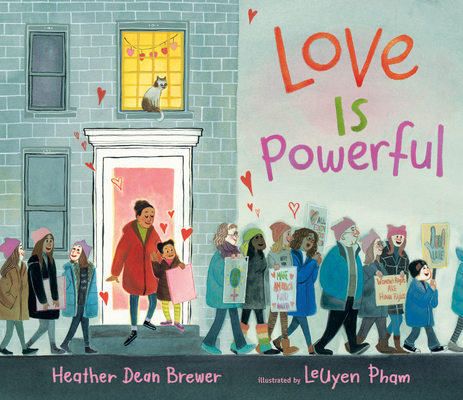
Love Is Powerful (Peace Library Review)

by Heather Dean Brewer, author; and LeUyen Pham, illustrator
review by Anne Stokes


Heather Dean Brewer is a writer, artist, and art director who designs books for kids and adults and loves to ride her bike in the woods. About this book she says, “I’ve often felt quiet and small and that no one could hear me. But when I joined others in the Women’s March and saw my friend Mari lifted above the crowd and heard her voice echo down the streets of New York City, I learned that even the smallest voice has the power to change the world. She lives in Michigan with her family.

The title says it all. Love is powerful.

Based on a true story from the Women’s March in 2017, we meet young Mari whose mother helps her make a sign and takes Mari and her sign to a protest march-a march to oppose unkind speech and injustice. Mari worries that her sign is too small and no one will see it. She worries that her voice is too small and the hundreds of people she sees won’t hear it.

But, when Mari sits on her mom’s shoulders, raises her sign and reads out “Love is Powerful!” someone hears and repeats it. Then others join in, and soon the whole crowd is chanting “Love is Powerful!”

This book is beautifully illustrated, and carries the message that every voice matters, that love can stamp out hate, that we can all use our voices and words to peacefully advocate for change.

After reading this book children may want to make signs with kind speech and practice raising their voices in an at-home march. They may explore other kind words that they can use.

As a Faith Reflection you may want to read:

Psalm 33:5
“He loves righteousness and justice; the earth is full of the steadfast love of the Lord.”

Discuss where you might see signs of justice and peace in the world. Where might you see signs of God’s love in the world?

Mark 12:30-31
“… you shall love the Lord your God with all your heart and with all your soul and with all your mind and with all your strength. The second is this, ‘You shall love your neighbor as yourself.’ There is no other commandment greater than these.”

Discuss ways to show love in our family, in our community, in the world.

Short prayer
“Bless us with Love, O God. May we love as you Love! Help us show patience, tolerance, kindness, caring and love to all!”

— Anne H. Stokes

Categories
From the Clergy Uncategorized

Opening the Book of Common Prayer

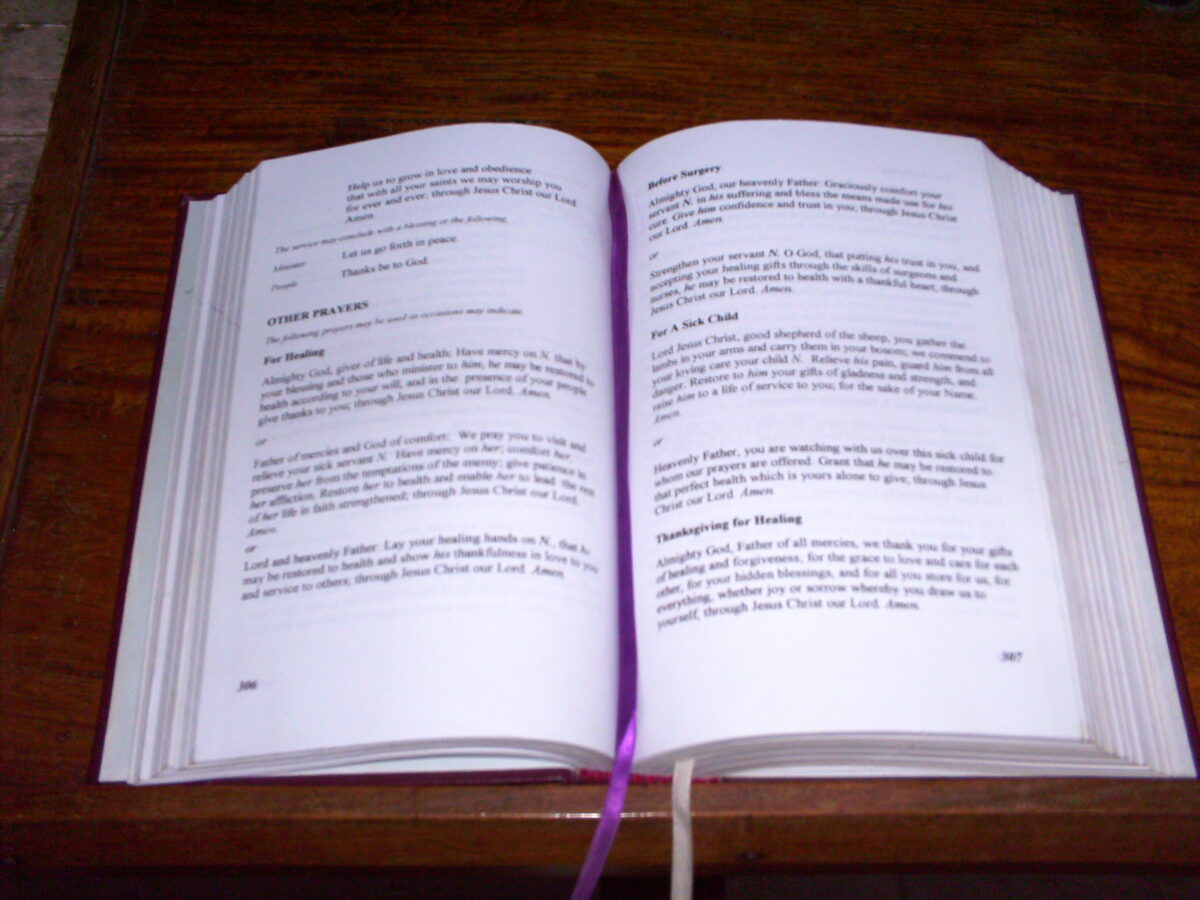
When you are sitting in the pews of the Church of the Nativity, you might be asked to turn to a page of the Book of Common Prayer. And when you pull the book out of the book holder and open the book, you notice that the pages are yellow in a certain section of the book. As you move to open the book, the book pages automatically fall open to a certain page, most likely page 355: The Holy Eucharist: Rite Two. Generations of hands have been opening these books, and turning to that section so that the book knows where you need to go.

And chances are, after a while, you don’t need to open the book to page 355, because the rhythm of the opening of the service is inscribed in your brain:

Blessed be God: Father, Son, and Holy Spirit.
And blessed be his kingdom, now and forever. Amen.

And now because you know it by heart, you have noticed the people around you saying “And blessed be GOD’S kingdom…” and so you start saying it too, because the idea of God being confined to one gender has opened up your ideas about God, and you are experiencing the Book of Common Prayer being just that – a book that the people of God use to express their prayers to a God they know in their own language.

And you do need to turn to the page with the Gloria (356) or if you are attending 10:30, you don’t need to because you are singing it and it turns out that singing helps you memorize texts and those tunes and those words get deep into your soul so that one day you find yourself singing it to yourself when your soul needed to feel the presence and reminder of God, “For you alone are the Holy One, you alone are the Lord…”

And after a season or two of turning to page 361, or page 367, for Eucharistic prayers A or B, you start to recognize which prayer, and again, your soul remembers those words, “Christ has died. Christ has risen. Christ will come again.” And you notice you don’t need to scramble for the book after communion and can join the rhythm of “Eternal God, heavenly Father, you have graciously accepted us as living members…” and later in the day in the grocery store line as you feel guilty for all that you didn’t accomplish during the week or weekend, those same words come into your mind and you remember what it feels like to be graciously accepted.

The words of the Book of Common Prayer are soulful words spoken by generation after generation. When we reach for the prayer book, we are joining with Episcopalians and Anglicans around the world who might not agree on every theological tenant, but we do agree that these words can still express our soul’s deep longing for a living experience of God.

And yes, we can read those words in a printed pamphlet just as well, and we will use the printed bulletin during certain seasons of the church year because our tradition holds a wealth of other prayers to say new things to our souls. But there is something important in opening the book, holding the weight in your hands, flipping through and noticing the abundance of other prayers found there, not just what we do on Sunday morning. When our children play with the books and read those prayers because the sermon is going on a bit too long, they are joining generations of children who have sat in pews in Episcopal churches doing the same, feeding those growing souls with the words they need, helping the language of the prayer book become their language too.

Is it confusing the first few times you use the book? Yep. Is it awkward to balance a prayer book, hymnal, and bulletin? Absolutely. Will it feel that way forever? No. These next few Sundays, I encourage you, when you hear, “Our service begins on page 355,” take a moment to feel the weight of the book in your hands, notice the yellowed pages, and allow the words to sink into your soul. Be grounded and present in that moment, and may you feel God there with you.

— Rev. Stephanie

Categories
Glad Tidings

Chanting the Psalms

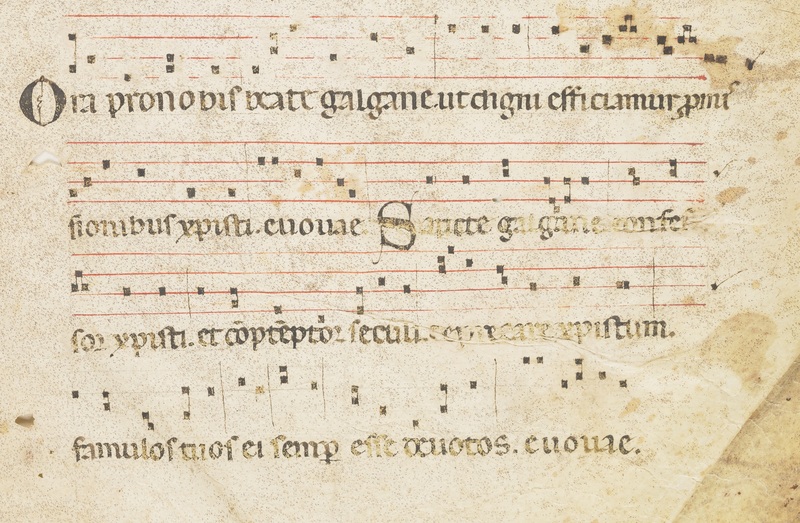
This Epiphany, we have reintroduced the appointed psalm into our Sunday lectionary readings. A wonderful tradition of the Anglican heritage is that of Anglican Chant, which is the practice of chanting the psalms. In contrast to Gregorian Chant (which is what most people think of when they think of “chant”), Anglican Chant feels a little more like hymn-singing, with its more familiar, balanced phrase lengths and harmonic movement.

At Nativity, we don’t have a long-standing tradition of Anglican Chant. However, chanting is not as difficult as many think. Last week — the First Sunday after the Epiphany — we recited the psalm antiphonally. This Sunday, we will chant the psalm using what’s known as Simplified Anglican Chant. Simplified Chant is a good introduction to the tradition of Anglican Chant, for a couple reasons:

  • the chants are much shorter (usually half the length of full Anglican Chant)
  • the chants are in unison, with everyone singing the same melody (unlike Anglican Chant, which is in four parts)

Our plan, as we reintroduce this practice into our liturgy, is to alternate reading and singing the psalm weekly.

Here are a few pointers (pun intended) to ease the transition into chanting.

What do the symbols mean?

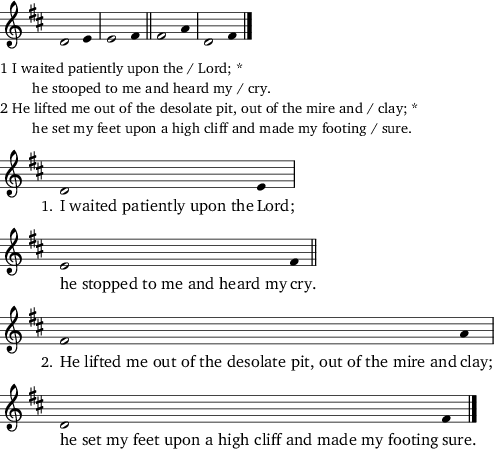
The psalms are “pointed”, which means that certain symbols are used to tell you when to change note. There are two main symbols in the text that we need to know to get started: the asterisk (*), and the slash (/).

The slash tells you when to change note. Most of the text is sung on what’s called the “chanting” note. These notes are white, or not colored in. The word(s) after the slash — usually only one or two syllables — are sung on the “moving” note. This is a black note, or a note that is colored in.

The asterisk indicates the half-way point of the verse. In the simplified chants, there is a “double bar line” in the music. This is important, because on odd-numbered verse psalms, we have to end with the second half of the tune. (The complete tune takes two verses of text to sing, so this ensures that we end the chanting with the end of the tune.)

Putting it all together, here is how the first two verses of Sunday’s psalm are realized:

It’s all about the text

Even though many Gregorian and Anglican chants have beautiful melodies, the text is really where the focus is. It’s quite possible to chant an entire passage on one note, and that is actually frequently done in some circles. (If you came to Evensong with the Raleigh Convocation Choir in December, you would have heard or participated in reciting the Apostles’ Creed in unison on one note.)

With the text being the central focus, it’s important to remember the natural rhythms of speech. It’s very easy to fall into the trap of chanting the same way you sing a hymn. But the text should dictate the rhythm and tempo (speed) of the chant — much as if you were speaking it.

— Bradley Burgess

Categories
Caring for Creation

The Pentagon, Climate Change and War

Creation Care webinar: The Pentagon, Climate Change and War
A Zoom Forum on January 17 at 12 noon
Carl Sigel

As people of faith, we glimpse the peace of heaven and seek a new world of peace here on earth.  Please join Interfaith Creation Care of the Triangle and other sponsors for this Zoom forum with Neta Crawford, Professor of International Relations at the University of Oxford in the U.K., discussing her new book on the Pentagon, the world’s largest single greenhouse gas emitter.  Tracing the U.S. military’s growing consumption of energy, Prof. Crawford calls for a re-conceptualization of foreign policy and military doctrine.  Only such a rethinking, she argues, will break the link between national security and fossil fuels.  Co-sponsored by Highland United Methodist Church Micah 6:8 Team, NC Peace Action and Interfaith Creation Care of the Triangle, Campaign Nonviolence, and Veterans for Peace.

Learn more and register here

This webinar is sponsored by Interfaith Creation Care of the Triangle (ICCT).